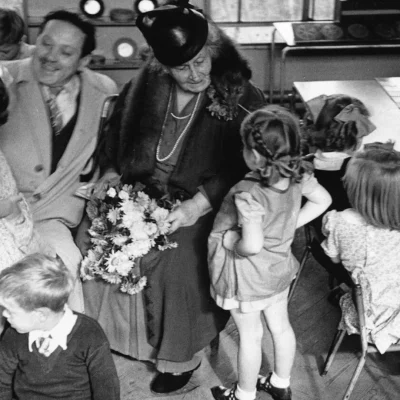
Montessori education instills a love of learning in the child that will last throughout their whole life. The most basic principle in Dr. Montessori’s method is that the learning capacity of a young mind is great; she called this: “the absorbent mind”. By the age of three, the child has already laid down the foundations of his/her personality as a human being.
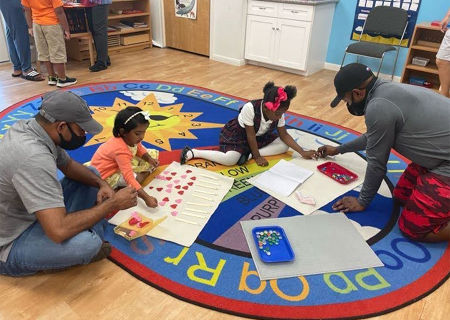
This is why it is crucial for young children to be able to learn by exploration in a “prepared environment” – a Montessori classroom. A Montessori classroom will invite the child through learning materials which will help them develop into confident, capable, competent, and compassionate human beings.
Language
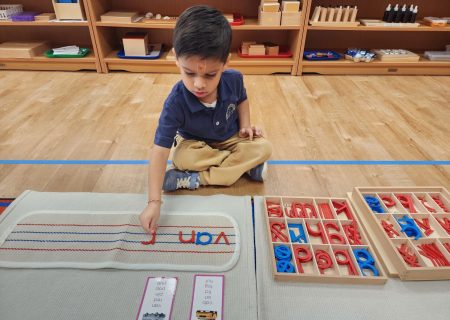
Language materials in our classrooms are thoughtfully created to build vocabulary and support the development of both spoken and written language. Activities like sandpaper letters and the moveable alphabet help children understand phonetic sounds and begin forming words on their own.
As they grow, children use hands-on tools to create their own writing, read what others have written, and express their thoughts and emotions with clarity and confidence.
Sensorial
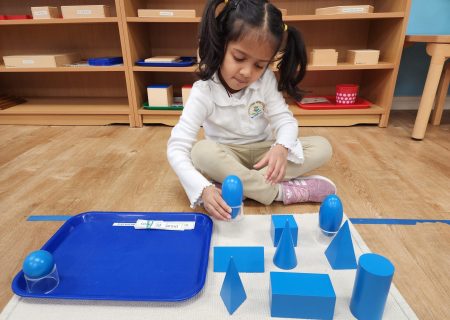
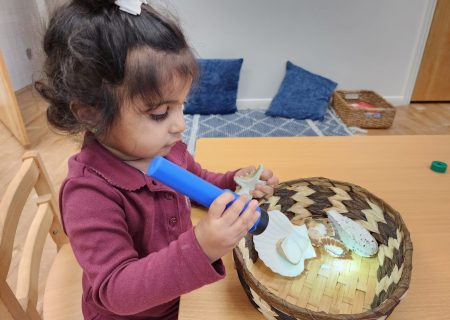
Sensorial materials, created by Dr. Maria Montessori, help children explore, understand, and organize the information they take in through their senses. These activities are designed to sharpen a child’s ability to observe, compare, and make thoughtful distinctions.
The materials target different sensory areas-including sight, touch, sound, taste, and smell-and often involve matching, sorting, and grading exercises. Each activity is carefully structured to focus on just one sense at a time, allowing children to develop their sensory awareness with clarity and accuracy.
Mathematics
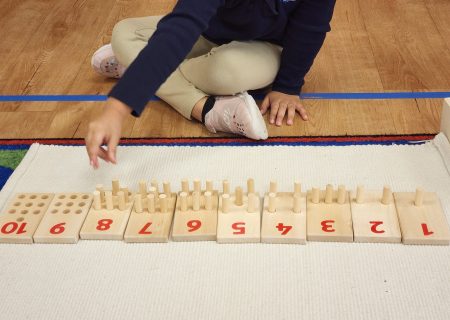
Mathematical concepts are introduced to the child using concrete sensorial materials. Initial explorations with sensory materials encourage children to understand basic math concepts such as learning number recognition, counting and sequencing of numbers.
Sensorial work prepares the child for a more formal introduction to mathematics, and the introduction of abstract mathematical concepts such as the decimal system and mathematical operations.
Practical Life
Practical Life activities teach children how to take care of themselves and the world around them. These everyday tasks build independence, which in turn boosts self-confidence and prepares children to handle new situations with ease.
Exercises in this area include lessons in grace and courtesy, personal care, and caring for the environment. They help develop coordination, focus, and self-reliance, while also laying the foundation for skills needed in writing and reading. Children engage in hands-on tasks like cleaning, preparing food, polishing, and watering plants—building both practical skills and a sense of responsibility.
Culture Subjects
Cultural activities lead the child to experience music, stories, artwork and items from the child’s community, society and cultural background. The areas of geography, science, zoology and botany are all included in this area.
A range of globes, puzzle maps and folders containing pictures from different countries all help to give the child an insight into different cultures. The culture area encourages children to develop their capacity for creation, and develop fine motor skills.